
Sunday, March 29, 2009


Tuesday, September 16, 2008
AC Theory

AC THEORY: AC Ohm's Law.
Ohm's Law can also be applied to AC circuits. However, alternating currents and voltages are continually changing. At the beginning of the cycle the voltage and current are zero, building to peak positive values at 90°, before declining back to zero, and then repeated in a negative direction.
It is therefore only possible to calculate instantaneous values of V or I throughout the cycle. Peak or RMS values are normally used.
The AC resistance of capacitors and inductors is called 'reactance' (measured in Ohms). As the frequency is increased, capacitive reactance decreases, whereas inductive reactance increases.
Once the reactance is calculated for C or L at the applied frequency, the value can be inserted in the formula as for resistance. Where there is a combination of resistance and reactance the calculation refers to 'impedance', symbol Z.
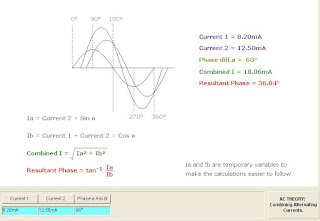 AC THEORY: Combining Alternating Currents.
When two or more currents flow in a DC circuit they can be added or subtracted directly. For parallel AC circuits the currents will be at phase angles determined by the circuit capacitive and inductive elements.
One way the resultant can be found is graphically as shown, by measuring the amplitudes of the instantaneous values for A and B throughout the waveform and adding. The resultant phase angle will tend to be towards the current making the greatest contribution to the resultant.
Phase differences greater than 90° are not considered, but it should be understood that they do arise in practical circuits.
The use of phasors is another approach. Select 'phasor diagrams topic' for an explanation.
 AC THEORY: Voltage and Current for R.
For the parallel AC circuit the voltage is common across all current branches of R, C and L. However, the current for each branch will have a phase angle determined by the resistive, capacitive or inductive element of that component.
For the capacitor, the current will 'lead' the voltage and for the inductor current will 'lag' the voltage. Whereas resistor currents and voltages will always be in phase.
The instantaneous amplitudes of both voltage and current can be found at any point throughout the AC waveform for phase angles of 0 to 360°.

AC THEORY: Voltage and Current for C.
For the parallel AC circuit the voltage is common across all current branches of R, C and L. However, the current for each branch will have a phase angle determined by the resistive, capacitive or inductive element of that component.
For the capacitor, the current will 'lead' the voltage and for the inductor current will 'lag' the voltage. Whereas resistor currents and voltages will always be in phase.
The instantaneous amplitudes of both voltage and current can be found at any point throughout the AC waveform for phase angles of 0 to 360°.

For the parallel AC circuit the voltage is common across all current branches of R, C and L. However, the current for each branch will have a phase angle determined by the resistive, capacitive or inductive element of that component.
For the capacitor, the current will 'lead' the voltage and for the inductor current will 'lag' the voltage. Whereas resistor currents and voltages will always be in phase.
The instantaneous amplitudes of both voltage and current can be found at any point throughout the AC waveform for phase angles of 0 to 360°.

AC THEORY: Voltage and Current for L.
For the parallel AC circuit the voltage is common across all current branches of R, C and L. However, the current for each branch will have a phase angle determined by the resistive, capacitive or inductive element of that component.
For the capacitor, the current will 'lead' the voltage and for the inductor current will 'lag' the voltage. Whereas resistor currents and voltages will always be in phase.
The instantaneous amplitudes of both voltage and current can be found at any point throughout the AC waveform for phase angles of 0 to 360°.
For the parallel AC circuit the voltage is common across all current branches of R, C and L. However, the current for each branch will have a phase angle determined by the resistive, capacitive or inductive element of that component.
For the capacitor, the current will 'lead' the voltage and for the inductor current will 'lag' the voltage. Whereas resistor currents and voltages will always be in phase.
The instantaneous amplitudes of both voltage and current can be found at any point throughout the AC waveform for phase angles of 0 to 360°.
Wednesday, August 6, 2008
JENIS - JENIS LITAR ELEKTRIK
Litar elektrik merupakan suatu susunan pengalir atau kabel untuk membawa arus dari punca bekalan voltan ke komponen-komponen elektrik (beban). Ianya terbahagi kepada dua iaitu:
1.3.1 Litar Lengkap
Ia juga dikenali sebagai litar asas atau litar mudah (Rajah 1.1). Ia merupakan suatu penyambungan tertutup yang membolehkan arus mengalir dengan sempurna iaitu arus mengalir dari bekalan dan balik semula ke bekalan tersebut. Litar-litar tersebut mestilah terdiri daripada voltan bekalan (V), arus elektrik (I) dan rintangan (R).
1.3.2 Litar Tidak Lengkap
Litar tidak lengkap ialah litar yang mengalami kekurangan salah satu daripada tiga perkara tersebut iaitu samada voltan bekalan atau rintangan beban. Pengaliran arus tidak akan berlaku dengan sempurna pada litar tidak lengkap. Litar tidak lengkap terbahagi kepada dua ;
1.3.2.1 Litar buka - litar dimana punca beban dalam litar tersebut dibuka. Oleh itu tiada pengaliran arus berlaku. Nilai rintangan dalam litar adalah terlalu tinggi. Rajah 1.2 menunjukkan satu contoh litar buka.
1.3.2.2 Litar pintas - sambungan pada punca bebannya dipintaskan dengan menggunakan satu pengalir yang tiada nilai rintangan. Ia ditunjukkan seperti Rajah 1.3 Arus yang mengalir adalah terlalu besar. Biasanya jika berlaku litar pintas, fius akan terbakar.
1.3.1 Litar Lengkap
Ia juga dikenali sebagai litar asas atau litar mudah (Rajah 1.1). Ia merupakan suatu penyambungan tertutup yang membolehkan arus mengalir dengan sempurna iaitu arus mengalir dari bekalan dan balik semula ke bekalan tersebut. Litar-litar tersebut mestilah terdiri daripada voltan bekalan (V), arus elektrik (I) dan rintangan (R).
1.3.2 Litar Tidak Lengkap
Litar tidak lengkap ialah litar yang mengalami kekurangan salah satu daripada tiga perkara tersebut iaitu samada voltan bekalan atau rintangan beban. Pengaliran arus tidak akan berlaku dengan sempurna pada litar tidak lengkap. Litar tidak lengkap terbahagi kepada dua ;
1.3.2.1 Litar buka - litar dimana punca beban dalam litar tersebut dibuka. Oleh itu tiada pengaliran arus berlaku. Nilai rintangan dalam litar adalah terlalu tinggi. Rajah 1.2 menunjukkan satu contoh litar buka.
1.3.2.2 Litar pintas - sambungan pada punca bebannya dipintaskan dengan menggunakan satu pengalir yang tiada nilai rintangan. Ia ditunjukkan seperti Rajah 1.3 Arus yang mengalir adalah terlalu besar. Biasanya jika berlaku litar pintas, fius akan terbakar.
Subscribe to:
Posts (Atom)
sam


